Thursday, 5 January 2017

Desperately seeking young people

MIEKO TERADA moved to Tama in 1976, at about the same time as everyone else there. Back then, the fast-growing city in Tokyo’s suburban fringe was busy with young married couples and children. These days, however, the strip of shops where Ms Terada runs a café is deathly quiet, her clientele elderly. The people of Tama and their apartments are all growing old and decrepit at the same time, she says.

In the mid-1990s Japan had a smaller proportion of over-65s than Britain or Germany. Thanks to an ultra-low birth rate, admirable longevity and a stingy immigration policy, it is now by far the oldest country in the OECD. And senescence is spreading to new areas. Many rural Japanese villages have been old for years, because young people have left them for cities. Now the suburbs are greying, too.

Between 2010 and 2040 the number of people aged 65 or over in metropolitan Tokyo, of which Tama is part, is expected to rise from 2.7m to 4.1m, at which point one-third of Tokyo residents will be old. In Tama, ageing will be even swifter. The number of children has already dropped sharply: its city hall occupies a former school. Statisticians think the...Continue reading

from Asia http://ift.tt/2iFkX4j
via https://ifttt.com/ IFTTT

Some Muslim politicians in Indonesia want a total ban on booze

ONE of Indonesia’s newest brands of beer, Prost, traces its ancestry back to 1948 when Chandra Djojonegoro, a businessman, started selling a “health tonic”, known as Anggur Orang Tua, from the back of a bright-blue lorry at night markets in the coastal city of Semarang. A troupe of dancing dwarves would pull in the punters, while Djojonegoro peddled shots of what was, in essence, a fortified herbal wine to fishermen. It kept them warm during the chilly nights in the Java Sea.

The tonic is still sold in bottles with distinctive labels depicting an old Chinese man with a thick white beard. The company that makes it now produces a vast range of consumer goods, and Prost beer is the latest addition to its range. It is made in a $50m brewery that opened in August 2015, filled with shiny stainless-steel machinery from Germany. Thomas Dosy, chief executive of the subsidiary that produces Prost, says that given Orang Tua’s history in the booze business it was natural for the company to move into Indonesia’s $1bn-a-year beer market.

It will not be straightforward. Conservative Muslim groups have become more assertive. Only months before...Continue reading

from Asia http://ift.tt/2hV6Bsz
via https://ifttt.com/ IFTTT

New Zealand debates a hiking fee

Welcome to Orcland

NEW ZEALAND’S chief conservation officer, Lou Sanson, caused a stir in October by suggesting that it might be time to start charging tourists for using the country’s wilderness trails. New Zealanders are keen fans of their national parks. Many would be outraged at having to pay. But many also worry about a huge influx of foreigners who have been seeking the same delights.

In 2016 New Zealand hosted 3.5m tourists from overseas; by 2022 more than 4.5m are expected every year—about the same as the country’s resident population. Tourism has overtaken dairy produce as the biggest export, helped by a surge in the number of visitors from China. The national parks, which make up about one-third of the territory, are a huge draw. About half of the foreign tourists visit one. They are keen to experience the natural beauty promised by the country’s “100% Pure New Zealand” advertising campaign (and shown off in the film adaptations of “The Lord of the Rings” and “The Hobbit”, which were shot in New Zealand’s breathtaking wilderness).

But for every happy Chinese couple snuggling up for...Continue reading

from Asia http://ift.tt/2iFhMtn
via https://ifttt.com/ IFTTT

As Japan ages, so too does its workforce

LIKE many firms in Aichi prefecture, Japan’s manufacturing heartland, Nishijimax, a maker of machine tools for the car industry, is struggling to find workers. Its solution in a country with a drum-tight labour market is one that is increasingly common in Japan: raising the age of retirement. More than 30 of the company’s 140 employees are over 60; the oldest is 82. Putting qualified people out to pasture early is a waste, says Hiroshi Nishijima, a manager; “If they want to work, they should.”

Since peaking at over 67m in the late 1990s, Japan’s workforce has shrunk by about 2m. The government says it could collapse to 42m by mid-century as the population ages and shrinks. The number of foreigners inched up in 2015 to a record high of 2.2m, but that is far from enough to fill the labour gap. Instead of opening its doors wider to immigrants, Japan is trying to make more use of its own people who are capable of working.

Large companies in Japan mostly set a mandatory retirement age of 60—mainly as a way of reducing payroll costs in a system that rewards seniority. But other businesses are less stringent. About 12.6m Japanese...Continue reading

from Asia http://ift.tt/2hV2tZu
via https://ifttt.com/ IFTTT

Najib Razak appears secure, but looks can deceive

A ROUND of applause, ladies and gentlemen. Any typical leader of a typical democracy, when found with nearly $700m of ill-explained money from an unnamed foreign donor in his accounts, would experience a swift and fatal fall. Yet, nearly two years after news first broke that Najib Razak’s bank balance had been thus plumped up, his high-wire act continues.

You could even argue that the Malaysian prime minister, who denies any wrongdoing, is at the top of his game. Mr Najib appears to command the unstinting loyalty of the party, the United Malays National Organisation (UMNO), which leads the coalition that has ruled the country since independence in 1957. He has undermined a fractious opposition, not least by peeling an Islamist party away from it. And as investigations proceed in several other countries into the alleged bilking of colossal sums from 1MDB, an indebted state investment-fund whose advisory board Mr Najib once chaired, the prime minister himself remains untouched. Staying in power helps stave off any risk he might face of international prosecution. A general election is due by late August 2018, but perhaps Mr Najib will call a snap poll in...Continue reading

from Asia http://ift.tt/2iFwLDR
via https://ifttt.com/ IFTTT

Carnage at a prison in the Amazon

THE rampage lasted 17 hours. By the end of it, 56 inmates of the Anísio Jobim prison complex in Manaus, a city set amid the Amazon rainforest, were dead. Many had been decapitated; severed arms and legs were stacked by the entrance to the jail, known to most as Compaj, a contraction of its full name. Luís Carlos Valois, a judge who negotiated an end to the violence on January 2nd, called the hellish scene “Dantesque”. It was Brazil’s bloodiest prison riot in a quarter-century.

Only the death toll makes the carnage at Compaj stand out. Brazil’s prisons erupt often. Last year 18 inmates died in clashes between gangs at prisons in the northern states of Roraima and Rondônia. In Pernambuco, a north-eastern state whose prisons are overstuffed even by Brazilian standards, violent deaths are a frequent occurrence. In January 2016, 93 prisoners broke out of two of the state’s jails.

Prisons are both hellholes and headquarters for Brazil’s most powerful criminal gangs. The country’s prison population of 622,000, the world’s fourth-largest, is crammed into jails built to hold 372,000 inmates. Compaj houses 2,200, nearly four times its...Continue reading

from Americas http://ift.tt/2hWpQVZ
via https://ifttt.com/ IFTTT

Bolivia’s president chafes against term limits

Why stop in 2025?

AS 2016 drew to a close, a resignation letter from Bolivia’s president, Evo Morales, lit up social media. It was a hoax, perpetrated on día de los inocentes (“day of the innocents”), the Latin American version of April Fools’ Day, which falls on December 28th. The unamused communications minister, Marianela Paco, denounced it as an “attack on the people’s right to reliable and truthful news”.

In fact, Mr Morales’s allies are scheming to keep him in office indefinitely, even though, in a referendum last February, Bolivians voted to deny him the right to run for a fourth term in 2019. On December 17th his party, the Movement to Socialism (MAS), named him as its presidential candidate for the next election. “If the people decide it, Evo will continue,” Mr Morales promised his supporters.

The clamour to keep him is not a sign of recent success. Bolivia is suffering from a severe drought, whose effects are made worse by the government’s failure to plan and invest. Economic growth, which sustained Mr Morales’s popularity for most of his 11 years in office,...Continue reading

from Americas http://ift.tt/2hWNstl
via https://ifttt.com/ IFTTT

The high economic costs of India’s demonetisation

MOST economists might hazard a guess that voiding the bulk of a country’s currency overnight would dent its immediate growth prospects. On November 8th India took this abstruse thought experiment into the real world, scrapping two banknotes which made up 86% of all rupees in circulation. Predictably, the economy appears indeed to have been hobbled by the sudden “demonetisation”. Evidence of the measure’s costs is mounting, while the benefits look ever more uncertain. 

At least the new year has brought a semblance of monetary normality. For seven weeks queues had snaked around banks, the main way for Indians to exchange their old notes for new ones or deposit them in their accounts. That is over, largely because the window to exchange money closed on December 30th. The number of fresh notes that can be withdrawn from ATMs or bank counters is still curtailed, but the acute cash shortage is abating, at least in big cities.

As data trickle through, so is evidence of the economic price paid for demonetisation. Consumers, companies and investors all wobbled in late 2016. Fast-moving consumer goods, usually a reliable growth sector, retrenched...Continue reading

from Economics http://ift.tt/2hWvHKN
via https://ifttt.com/ IFTTT

Supervisors put off finalising reforms to bank-capital rules

SOME banks find existing capital requirements too taxing. To no one’s surprise, on December 23rd Monte dei Paschi di Siena, at present Italy’s fourth-biggest bank, asked the Italian state for help, having failed to raise from the private sector €5bn ($5.2bn) in capital demanded by the European Central Bank before the year’s end. Three days later Monte dei Paschi said that the ECB had redone its sums—and concluded that the stricken lender faced an even bigger shortfall, of €8.8bn.

Plenty of other European banks—in far better nick than poor old Monte dei Paschi, which is overloaded with bad loans—are grumbling that they too may eventually have to find more capital. They have spent years plumping up cushions that the financial crisis showed to be worryingly thin, but fear that proposed adjustments to Basel 3, the latest global standards, will require more. The Basel Committee on Banking Supervision, which draws up the standards, had hoped to agree on the revisions by the end of 2016. It’s not there yet: on January 3rd an imminent meeting of central-bank governors and supervisors, to approve the changes, was postponed.

The...Continue reading

from Economics http://ift.tt/2hWzLe7
via https://ifttt.com/ IFTTT

2016 may have been an economic as well as political turning-point

THANKS to Brexit and the election of Donald Trump, 2016 is widely viewed as a political turning-point. But it may also come to be seen as an economic turning-point, marking the third big change of direction since the second world war.

The post-war period from 1945 to 1973 was the era of the Bretton Woods system of fixed exchange rates and capital controls. It was a time of rapid economic growth in the rich world as countries rebuilt themselves after the war and as the technological innovations of the first half of the 20th century—cars, televisions, and so on—came into widespread use. High taxes reduced inequality; fiscal policy was used to control the economic cycle. It all came crashing down in the early 1970s as the fixed-currency system collapsed, and an oil embargo imposed by Arab producers ushered in stagflation (ie, high unemployment combined with inflation).

By the early 1980s, a new system had emerged. Currencies floated, capital controls were abolished, the financial sector was liberalised, industry was privatised and tax rates on higher incomes were cut. In this system inequality widened again (although...Continue reading

from Economics http://ift.tt/2j8lOaE
via https://ifttt.com/ IFTTT

“Open outcry” is in retreat but futures and options trading-volumes surge

Nothing to outcry about

AS A new trading year began this week in the art-deco tower that houses the Chicago Board of Trade, big men were clustered around pits dealing in futures and options tied to various commodities. Their approach dates back to the building’s opening in 1930, and was once familiar in cities throughout America. But after decades of attrition, on December 30th the CME Group (named after the Chicago Mercantile Exchange) closed the “open outcry” trading pits that it operated in New York. In America, Chicago’s hue and cry has become unique.

Even this exchange is a shadow of its former self. There are now nine pits, down from 32 in 2007. A once teeming trading floor was closed in 2015. Most activity in the contracts still traded in the pits is electronic. No one in the surviving CME pits in Chicago seems worried by the New York closures. But they have a symbolic impact. The markets have long been a colourful, fractious component of America’s financial architecture.

They have always lured the ambitious. Two alumni of New York’s commodity markets have joined the Trump administration. Gary...Continue reading

from Economics http://ift.tt/2j8bwrg
via https://ifttt.com/ IFTTT

Anthony Atkinson, a British economist and expert on inequality, died on January 1st

“TIME is of the essence,” wrote Sir Anthony Atkinson, a British economist, in a report on measuring global poverty, published in July 2016. His sense of urgency may have been influenced by another constraint. In 2014 Sir Anthony had been diagnosed with incurable cancer. Some might have paused; he sped up. He chaired the World Bank commission that produced the poverty report, and wrote a book, “Inequality: What Can Be Done?”, in just three months. On January 1st, his time ran out.

In his lifetime, he was tipped for a Nobel prize. On his death, fellow economists rushed to describe him as “one of the all-time greats” and emphasised his extraordinary “decency, humanity and integrity”. The two were linked. For him, economics was about improving people’s lives.

A six-month stint volunteering as a nurse in a hospital in deprived inner-city Hamburg was an early influence. He saw poverty, and went on to spend his life combating it. He fought his battles gently—shying away from the adversarial style he experienced as a student at Cambridge—but with rigorous precision and an unfailing sense of social justice.

As...Continue reading

from Economics http://ift.tt/2hWvck4
via https://ifttt.com/ IFTTT

When stars die, insurers count the cost

Carrie trade

THE death of Carrie Fisher, a much-loved actor in the “Star Wars” movies, left a hole in the force for fans. It may also burn a hole in the pockets of underwriters, syndicated under Lloyds of London. They may have to fork out as much as $50m to meet Disney’s claim for its loss. The studio, which owns the sci-fi saga, had wisely taken out so-called contractual-protection insurance (CPI) in case death thwarted a contractual obligation: in Ms Fisher’s case to film and promote future “Star Wars” episodes.

Contrary to the headlines, 2016 was not an especially lethal year to be a celebrity. Like the rest of us, they do die. But unlike most of us, their employers can be left with astronomic bills. When Paul Walker, an actor in “The Fast and the Furious”, a series of action movies, died in 2013 while filming the seventh instalment, Universal Pictures had to spend considerable effort (and dollars) to make his on-screen persona live on. This included hiring body-doubles and digitally inserting Mr Walker into the movie with hundreds of computer-generated images.

Most workers are easier to...Continue reading

from Economics http://ift.tt/2j8haJS
via https://ifttt.com/ IFTTT

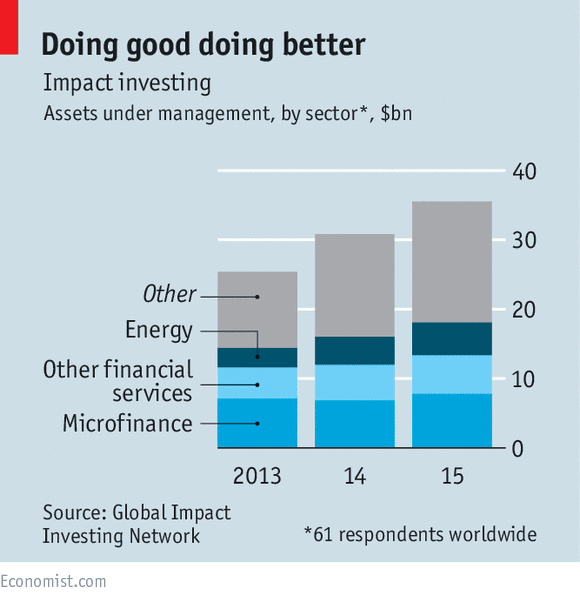
“Impact investing” inches from niche to mainstream

WHEN investors gathered in Amsterdam in late 2016 for perhaps the largest annual conference on “impact investing”, the mood was upbeat. The concept of investing in assets that offer measurable social or environmental benefits as well as financial returns has come a long way from its modest roots in the early 2000s. Panellists at the conference included, among others, representatives of two of the world’s largest pension funds, TIAA of America and PGGM of the Netherlands, and of the asset-management arm of AXA, a French insurance behemoth. A niche product is inching into the mainstream.

In the past two years BlackRock, the world’s biggest asset manager, launched a new division called “Impact”; Goldman Sachs, an investment bank, acquired an impact-investment firm, Imprint Capital; and two American private-equity firms, Bain Capital and TPG, launched impact funds. The main driver of all this activity is investor demand. Deborah Winshel, boss of BlackRock Impact, points to the transfer of wealth to women and the young, whose investment goals, she says, transcend mere financial returns. Among institutions, sources of demand have...Continue reading

from Economics http://ift.tt/2hV9MQV
via https://ifttt.com/ IFTTT

An attack on an Istanbul nightclub widens the secular-religious divide

AFTER a year of terrorist attacks and a violent coup attempt, Istanbul residents are getting used to the sound of explosions. When blasts rang out near the city’s best-known nightclub just after 1am on January 1st, some thought they were new-year pyrotechnics. Yet the skies above them were empty. A massacre was unfolding below. By the time it was over at least 39 people, mostly foreigners, were dead, and dozens more wounded. Autopsies suggested that many had been shot at close range. Some saved themselves by leaping into the Bosporus. As The Economist went to press the attacker, a suspected follower of Islamic State (IS), had not been caught. 

IS has carried out at least eight big attacks in Turkey, including the deadliest in the country’s history, a suicide-bombing that killed more than 100 people in October 2015. The nightclub attack is the first it has undisputedly claimed. In an online statement the group praised the shooting as an attack on an “apostate” celebration and revenge for a Turkish offensive against it in Syria. Turkey’s army cleared IS from strongholds overlooking the border in early September, and...Continue reading

from Europe http://ift.tt/2iIbvuO
via https://ifttt.com/ IFTTT

Vladimir Putin wins his last round against Barack Obama

IT WAS Vladimir Putin as we have come to know him: unpredictable, cynical and skilful at trumping real events with propaganda. On December 29th Barack Obama expelled 35 Russian diplomats involved in intelligence work (along with their families), ordered two Russian diplomatic compounds in America closed, and imposed fresh sanctions against Russian security agencies and a list of individuals. Mr Obama was retaliating for Russian interference in America’s elections, which included hacking the computers of high-level Democratic Party officials and leaking the embarrassing contents to the press. The White House expected Russia to eject an equal number of American diplomats. Instead, Mr Putin responded asymmetrically, parrying the American action and mocking Mr Obama as a bitter loser.

Mr Putin’s performance was carefully choreographed. In the first move Sergei Lavrov, the foreign minister, appeared on state television to declare that Russia would respond to America’s actions in kind. The foreign ministry and other agencies, he said, had proposed to Mr Putin that 31 diplomats from the American embassy and four diplomats from the consulate in St...Continue reading

from Europe http://ift.tt/2hWnGpl
via https://ifttt.com/ IFTTT

How Martin Luther has shaped Germany for half a millennium

SET foot in Germany this year and you are likely to encounter the jowly, dour portrait of Martin Luther. With more than 1,000 events in 100 locations, the whole nation is celebrating the 500th anniversary of the monk issuing his 95 theses and (perhaps apocryphally) pinning them to the church door at Wittenberg. He set in motion a split in Christianity that would forever change not just Germany, but the world.

At home, Luther’s significance is no longer primarily theological. After generations of secularisation, not to mention decades of official atheism in the formerly communist east (which includes Wittenberg), Germans are not particularly religious. But the Reformation was not just about God. It shaped the German language, mentality and way of life. For centuries the country was riven by bloody confessional strife; today Protestants and Catholics are each about 30% of the population. But after German unification in the 19th century, Lutheranism won the culture wars. “Much of what used to be typically Protestant we today perceive as typically German,” says Christine Eichel, author of “Deutschland, Lutherland”, a book about Luther’s...Continue reading

from Europe http://ift.tt/2iU2bUx
via https://ifttt.com/ IFTTT

Motorway tolls are hurting German-Austrian relations

EVERY winter, northern Europeans bound for ski holidays zip insouciantly through the Netherlands, Belgium and Germany on motorways that are free of charge. But near the borders of Austria or Switzerland they must pull over to buy stickers so that they can drive on the Alpine motorways—even as Austrian and Swiss cars zoom in the opposite direction onto Germany’s free Autobahn. To the perceived injustices in the European Union (EU), add another: the nuisances of a quilt of road-tolls.

Bavarians are particularly cranky. If you live in Munich, say, work and play extend naturally across the border. Hence the grousing about paying on Austrian roads while Austrians “free-ride” on Bavarian ones. In 2013 the CSU, a regional party that governs Bavaria, made fixing “this unfair situation” a condition for joining the coalition of the chancellor, Angela Merkel. The CSU’s Alexander Dobrindt, who became transport minister, got to work.

Continue reading

from Europe http://ift.tt/2hWDNTP
via https://ifttt.com/ IFTTT

South Africa has one of the world’s worst education systems

AFTER half an hour of pencil-chewing Lizeka Rantsan’s class lines up at her desk to hand in its maths tests. The teacher at Oranjekloof primary school in Cape Town thanks the 11- and 12-year-olds and flicks through the papers. Ms Rantsan sighs, unimpressed. Pulling one sheet of errant scribbles from the pile she asks: “How are we supposed to help these children?” 

It is a question that South Africa is failing to answer. In a league table of education systems drawn up in 2015 by the OECD club of mainly rich countries, South Africa ranks 75th out of 76. In November the latest Trends in International Mathematics and Science Study (TIMSS), a quadrennial test sat by 580,000 pupils in 57 countries, had South Africa at or near the bottom of its various rankings (see chart), though its scores had improved since 2011. Its children are behind those in poorer parts of the continent. A shocking 27% of pupils who have attended school for six years cannot read, compared with 4% in Tanzania and 19% in Zimbabwe. After five years of school about half cannot work out that 24 divided by three is eight. Only 37% of children starting school go on to pass the...Continue reading

from Middle East and Africa http://ift.tt/2hVnd8j
via https://ifttt.com/ IFTTT

A goody and Abadi

THEY said it would be over by Christmas. Now Haider al-Abadi, Iraq’s prime minister, is suggesting that the battle for Mosul could last until Easter. For almost a month his forces had stalled on what was supposed to be the easier eastern bank of Iraq’s second city. And the costs have been gruelling. A fifth of Iraq’s elite force has reportedly fallen in the assault. With the support of more American special forces, Mr Abadi has launched a second phase, taking the city’s industrial zone. Progress is being made. But what Iraqi soldiers clear by day, Islamic State (IS) fighters often regain by night, thanks to a warren of tunnels under the front lines.

Not only are IS fighters holding the line against Iraqi soldiers and their American backers after ten weeks of fighting in Mosul, but they are also fending off Turkish troops 515km (320 miles) to the west, around the town of al-Bab in northern Syria. They have also recaptured Palmyra from the Syrian regime.

Across Iraq the insurgency has a new lease of life. The sickening rhythm of suicide bombs in Shia suburbs of Baghdad and southern Iraq is quickening again. In Anbar and...Continue reading

from Middle East and Africa http://ift.tt/2hVfOGa
via https://ifttt.com/ IFTTT

President Trump may not be all good news for Binyamin Netanyahu

WITH its shopping malls, sports centres and new residential blocks, Maale Adumim (pictured above) looks and feels like any other Israeli dormitory suburb. Less than ten minutes’ drive eastward from Jerusalem, the town on the edge of the Judaean Desert, which is also the third-largest Jewish settlement in the West Bank, may be about to become the first test case of America’s Middle East policy under Donald Trump.

Elements of Binyamin Netanyahu’s right-wing coalition are agitating to annex parts of the West Bank, starting with Maale Adumim, in the belief that the Trump administration will reverse a long-standing American policy opposing Israeli settlements in territory it occupied in 1967.

The mayor, Benny Kashriel, says that he is not concerned about international politics so much as local laws: “I want my town to have the same rights as any other town in Israel.” He complains that, because the West Bank (called Judea and Samaria by the Israeli government) is under military rule, Maale Adumim’s residents need to apply to the army if they wish, for instance, to close a veranda: “There is no reason that the Israeli law shouldn’t...Continue reading

from Middle East and Africa http://ift.tt/2hVacvL
via https://ifttt.com/ IFTTT

Decriminalising the sex trade in Zimbabwe

Supply and demeaned

IT IS midnight at a shopping centre in Hopley, a poor suburb east of Harare. Masceline, an orphaned 15-year-old, stands in the darkness. Her aim is to find a client. But she also wants to avoid getting beaten up by older prostitutes who resent the competition she represents.

Zimbabwe’s Constitutional Court ruled in 2015 that the police could not arrest women for prostitution. At first, sex workers cheered. No more would they be dragged to police stations and shaken down for bribes to avoid six-month jail terms. It was a relief, too, for the many other women whom the cops used to arrest just for walking alone at night or drinking in a pub.

Yet there was a catch. Tambudzai Mikorasi, a 40-year-old sex worker, says she may have celebrated too early. Now that the oldest profession has been decriminalised, a flood of young women and girls are joining it and driving down prices. (Jobs of any kind are scarce thanks to Robert Mugabe’s disastrous management of the economy.)

Some veterans have responded by hiring thugs to protect their turf. In return, the men can have sex whenever they want....Continue reading

from Middle East and Africa http://ift.tt/2hVbMO8
via https://ifttt.com/ IFTTT

Astronomers and sheep farmers butt heads over the Square Kilometer Array

Where lambs once frolicked

THERE is a haunting beauty to the Karoo, a vast swathe of semi-desert that seems empty save for the stars overhead and sheep grazing below. Economic opportunities here are few. Scrubby, sprawling farms support sheep, ostrich, springbok and little else. (To be fair, Karoo lamb is delicious.)

But the Karoo’s clear skies also draw some of the world’s best scientists. A radio telescope project called the Square Kilometre Array (SKA) is under construction, with the latest cluster of 64 giant antennae due to be completed late next year. South Africa won the right to host half of the $2bn international project in 2012. When finished it will be the biggest radio telescope in the world and should allow scientists to peer into the origins of the universe.

Still, some sheep farmers are grumbling. Because of the sensitivity of the telescope, the surrounding area must be kept free from radio interference caused by everything from mobile phones to microwave ovens and some car engines. The SKA is buying up more farms than originally expected to ensure radio silence over an area of some 130,000...Continue reading

from Middle East and Africa http://ift.tt/2hV6Icp
via https://ifttt.com/ IFTTT
Chinese Yuan Is Other Side of Bouncing Bitcoin

Bitcoin’s record rally and fast plunge is more about the weakening of the Chinese yuan than a sudden crusade against fiat money.

from WSJ.com: Markets http://ift.tt/2jeqEan
via https://ifttt.com/ IFTTT

The “WTO option” for Brexit is far from straightforward

THE two sides of the Brexit debate do not agree on much, but they agree on this: if Britain fails to reach a trade deal with the EU it will have to revert to the “WTO option”. This involves trading only under rules set by the World Trade Organisation. The Leave camp is happy with this idea; Remainers less so. But the awkward truth is that the WTO option is not much of a fallback. Becoming an independent WTO member will be tortuous.

It is puzzling that Brexiteers, whose campaign was summed up as “Vote Leave, take back control”, seem happy with the WTO option. The WTO is truly global, with only a handful of countries outside it (zealous as they are about sovereignty, Brexiteers do not want to join the ranks of Turkmenistan and Nauru). But forsaking one unelected, unaccountable bureaucracy in Brussels for another housed in a leafy district of Geneva seems perverse. WTO members are at the mercy of its “dispute-settlement” regime, which allows other countries to enforce penalties.

Inconsistency has its upside. Membership of the WTO appears to be good for trade. Most economists believe Britain’s overall trade will suffer if Britain...Continue reading

from Economics http://ift.tt/2hRESsA
via https://ifttt.com/ IFTTT

Sub-national currencies struggle to survive

Five Bowies make a Winston

TUCKED away in a corner of Brixton, in south London, a rainbow-coloured ATM dispenses cash, looking for all the world like any other. But the notes it spews out are not pounds sterling. They are Brixton pounds (B£). Not to be mistaken for silly Monopoly money, the Brixton pound can actually be spent, legally: the currency, which has a fixed one-for-one exchange rate with sterling, is accepted at over 150 local shops and businesses. It can even be used to pay local taxes.

Launched in 2009, this is one of many such initiatives. Local currencies have been adopted in other towns and cities in Britain, such as Bristol, Exeter and Totnes. Elsewhere, examples include the eusko, used in the French Basques; BerkShares, used in western Massachusetts; and the Ithaca Hour, in Ithaca, New York. Barcelona plans an experiment in 2017.

Such schemes aim to boost spending at local retailers and suppliers, by encouraging the recirculation of money within a community. Because the currency is worthless outside its defined geographic area, holders spend it in the neighbourhood, thus creating a “local...Continue reading

from Economics http://ift.tt/2hVQkqk
via https://ifttt.com/ IFTTT

Commodities Find Support From Just About Everyone

Commodities in 2017 will be a tug of war between a softer China and surging activity everywhere else.

from WSJ.com: Markets http://ift.tt/2iHrMQS
via https://ifttt.com/ IFTTT

China's Electric Vehicle Strategy Paved With Potholes

China will be the world’s largest user of electric cars. It won’t necessarily dominate producing them.

from WSJ.com: Markets http://ift.tt/2jdBWvB
via https://ifttt.com/ IFTTT

The conviction of an IDF soldier divides Israel

ONE of the most contentious cases in Israel’s military history reached its verdict on January 4th when three military judges found a serving soldier, Sergeant Elor Azaria, guilty of manslaughter for killing a Palestinian.

The public controversy was not over the facts. Both the prosecution and defence agreed that on March 24th 2016, in the West Bank city of Hebron, Mr Azaria had fired point-blank at Abdel-Fattah al-Sharif, a Palestinian man lying grievously wounded after he had been shot while stabbing an Israeli soldier.

Nor was it over the court’s dismissal of Mr Azaria’s claim to have been acting in self-defence; the judges reached a unanimous decision that he had acted “calmly, without urgency and in a calculated manner” and that, as he said on the scene to a comrade, that he thought Mr al-Sharif “deserve[d] to die”.

Instead the controversy relates to the fact that a large section of the Israeli public seems to believe that Mr Azaria was right to have shot a wounded prisoner who no longer posed a danger. A poll last August by the Israeli Democracy Institute and Tel Aviv University indicated that 65% of Israel’s...Continue reading

from Middle East and Africa http://ift.tt/2iSAo6T
via https://ifttt.com/ IFTTT

Wednesday, 4 January 2017

Slippery Logic to Russia's Oil-Cut Claim

Russia’s pledge to cut output may have less impact on oil supply than the headlines suggest.

from WSJ.com: Markets http://ift.tt/2hRzK7U
via https://ifttt.com/ IFTTT

Envisioning a Fannie and Freddie Endgame

Fannie Mae and Freddie Mac can only be dealt with through a comprehensive solution that takes into account the interests of homeowners.

from WSJ.com: Markets http://ift.tt/2hSctrl
via https://ifttt.com/ IFTTT

How to lose votes and irritate people

SLYLY and without warning, on January 2nd Republican congressmen announced as their first major initiative of the new year a scheme so crassly self-interested as to suggest they had learned nothing from the old one. Denizens of a reviled institution, and a party railroaded by Donald Trump’s populist insurgency, the Republicans planned to gut the Office of Congressional Ethics (OCE): an independent investigative body designed to root out corruption among them. Less than 24 hours later, after a hail of condemnation, they turned tail; even so their bungling was damning.

The OCE was founded by the Democrats in 2008 after a run of scandals—including a big one concerning the Republican lobbyist Jack Abramoff—highlighted the impunity with which some lawmakers were abusing their office in exchange for campaign contributions. The office is empowered and equipped to investigate any allegation of impropriety.  It may then report its findings to the House Ethics Committee and, even if that body decides to take no further action, publicise them. Anti-corruption campaigners consider it an exemplary bulwark against official corruption. But many congressmen consider it over-zealous,...Continue reading

from United States http://ift.tt/2iG89eo
via https://ifttt.com/ IFTTT

The Bumpy Road Ahead for Bonds

The battle lines are being drawn for the bond market in 2017.

from WSJ.com: Markets http://ift.tt/2hQjZy2
via https://ifttt.com/ IFTTT

The manufacturing jobs delusion

INDUSTRIAL policy via Twitter is a new development in economics but we may all have to get used to it over the next four (or eight) years. Donald Trump's tweets on the car industry (and his planned cuts to corporate income tax) may or may not have persuaded Ford to keep a plant in Michigan, creating 700 jobs. But the problem with such headline-grabbing is that there are thousands of companies in the US, and jobs are being created or destroyed every day; intervening in all these situations is impossible. Even in cars, for example, GM has recently announced 3,300 lay-offs, almost five times greater than the Ford additions.  

History suggests that the aim of creating large numbers of manufacturing jobs will be a lost cause. In 1979, the high point for American manufacturing jobs was reached at 19.5m. The subsequent recession of the early 1980s caused that number to fall but there were regularly 17m-18m jobs in the 1980s and 1990s. From the turn of the millennium, however, the total fell pretty remorselessly, with the 2008-09 recession proving the coup de grace. The low was just under 11.5m in...Continue reading

from Economics http://ift.tt/2hRSxmW
via https://ifttt.com/ IFTTT

How China's Insurance Crackdown Spawns More Risks

Following a year of Chinese insurers aggressively building risky and illiquid portfolios, under loose regulation, China’s insurance regulator has taken to severe tightening measures in recent weeks.

from WSJ.com: Markets http://ift.tt/2i9vilU
via https://ifttt.com/ IFTTT

Macau Still Gambling King, Even Without High Rollers

Growth is back in Macau, the world’s largest gambling hub. But not all will benefit.

from WSJ.com: Markets http://ift.tt/2hP7OS6
via https://ifttt.com/ IFTTT

Why It's a Good Time to Restock Your Wine Cellar

Bordeaux prices have jumped this year in sterling terms, but remain close to multi-year lows in dollars.

from WSJ.com: Markets http://ift.tt/2iySGMV
via https://ifttt.com/ IFTTT

Donald Trump is poised to paint America’s judiciary red

PERHAPS the biggest decision Donald Trump faces in January is his choice of nominee for the Supreme Court. But the president-elect will have many more opportunities to make his mark on the judiciary. When Mr Trump takes office on January 20th, he will have over 100 vacant or soon-to-be vacant positions to fill in lower federal courts: 96 judgeships in district courts and 16 on the nation’s circuit courts. That accounts for about 1 in 7 seats in America’s 94 district courts and nearly 1 in 10 in the 13 powerful circuit courts that review district-court rulings. While the Supreme Court decides roughly 65 cases each term, lower courts handle tens of thousands of cases a year directly affecting millions of Americans' lives.

The unheralded but important role of the district-court judge was the theme of Chief Justice John Roberts’ end-of-year report on December 31st. “The men and women across the country who today serve as district judges”, he wrote, “are generally not well known” but “deserve tremendous respect”. Though it is typically the Supreme Court that is “the focus of public attention”, Mr Roberts observed, America’s “system of justice depends...Continue reading

from United States http://ift.tt/2i6uWN1
via https://ifttt.com/ IFTTT

Tuesday, 3 January 2017

How Credit-Card Data Might Be Distorting Retail Stocks

Hedge funds and other big investors are relying on credit-card data to give them an edge, and that could be affecting trading in retailers.

from WSJ.com: Markets http://ift.tt/2hOhwJd
via https://ifttt.com/ IFTTT

Making Banks Safer Waits for Another Day

Global regulators have delayed an agreement over “Basel IV” bank-capital rules that would bring U.S. and European lenders closer together.

from WSJ.com: Markets http://ift.tt/2iM7eWT
via https://ifttt.com/ IFTTT

In their search for independence, Catalans can resemble Brexiteers

IF YOU look up from the bustle of the winter tourists thronging the streets of Barcelona, you will see some balconies draped with the estelada, a blend of the Catalan and Cuban flags that has become the banner of those who want their land to become independent. There are fewer than there were, but still enough to inspire the Catalan regional government’s pledge that 2017 will be the year when it will hold a binding referendum on independence. Since the Spanish government refuses to contemplate such a vote, a confrontation seems inevitable.

Indeed, it has already begun. Some 300 Catalan officials face court cases for flouting the law, in acts ranging from a previous unilateral effort in 2014 to organise an independence vote to petty protests, such as flying the estelada from town halls. Carles Puigdemont, the president of the Generalitat (the Catalan government), promises to push through “laws of disconnection” next summer, such as one setting up its own tax agency, prior to holding a referendum, probably next September. His pro-independence coalition has a majority in the Catalan parliament. On December 14th Spain’s Constitutional Tribunal...Continue reading

from Europe http://ift.tt/2iEtV1W
via https://ifttt.com/ IFTTT

Wall Street Strategists Feel BetterTogether in 2017

High valuations and an unpredictable president-elect leave year-end forecasts more clustered together than ever before.

from WSJ.com: Markets http://ift.tt/2iuOZrl
via https://ifttt.com/ IFTTT

Peak Auto Sales Make 2017 a Waiting Game for Investors

U.S. car sales have stalled, leaving the automotive industry

from WSJ.com: Markets http://ift.tt/2iygVsm
via https://ifttt.com/ IFTTT

China and the Debt-Refinancing Game in 2017

Higher borrowing costs and weaker profits could be a combustible mix.

from WSJ.com: Markets http://ift.tt/2hKa11c
via https://ifttt.com/ IFTTT

Chinese Giant Turns Fresh Cash Into Future Burden

China Evergrande’s $4 billion stake sale may end up just being even more borrowing for the debt-laden developer.

from WSJ.com: Markets http://ift.tt/2hK54W5
via https://ifttt.com/ IFTTT

Monday, 2 January 2017

Why Super Mario's Run Was Short

Nintendo’s long-awaited mobile game still faces the challenge of few willing to pay.

from WSJ.com: Markets http://ift.tt/2ir3tbS
via https://ifttt.com/ IFTTT

Europe's True Missing Link: Economic Convergence

Politics is high on the 2017 agenda for Europe. The cause lies in economics.

from WSJ.com: Markets http://ift.tt/2iXiqPE
via https://ifttt.com/ IFTTT

China Infrastructure Is No Silver Bullet for Commodities

Spending on infrastructure in China won’t fully compensate for a slowdown in housing in terms of demand for metals.

from WSJ.com: Markets http://ift.tt/2i2QdHp
via https://ifttt.com/ IFTTT

The far right’s new fascination with the Middle Ages

UNTIL fairly recently, it was rare to find Americans who were passionate about both medieval history and contemporary politics. Barring the odd Christian conservative, medievalists tended to lean left: a Marxist grad student, say, mucking around in land ownership patterns to show how past inequalities gave birth to present ones, or an environmentalist activist, perhaps, fascinated with vegetable-dyed handspun clothing. But when Americans invoked historical events in politics, they tended to be more recent—the founding of the republic; the struggle against slavery and segregation; victory over Nazi Germany.

This has changed. Since the September 11 attacks, the American far right has developed a fascination with the Middle Ages and the Renaissance—in particular, with the idea of the West as a united civilisation that was fending off a challenge from the East. The trend has been prodded along by the movement's discovery of its European counterparts, which have used medieval and crusader imagery since the 19th century. This is troubling to many of those who study the Middle Ages for a living.

The embrace of the medieval extends from the alt-right online forum...Continue reading

from United States http://ift.tt/2iWfXFu
via https://ifttt.com/ IFTTT

Sunday, 1 January 2017

An attack in Istanbul on New Year’s Eve kills at least 39 people

IF ONE hope united Turks at the start of 2017 it was that the new year would bring respite from the horrors of the old one, the most violent the country has seen in decades. That hope died in a hail of bullets barely an hour after midnight on January 1st, when a gunman struck at one of Istanbul’s best known nightclubs, killing at least 39 people, including at least 15 foreigners, and wounding dozens more. An eyewitness quoted by a Turkish website said she lost consciousness after being crushed by a panicked crowd. “My husband...jumped on top of me. People ran over me,” she said. When she came to, she saw her husband covered in blood.

Official reports suggested that the attacker, armed with a machine gun, shot dead a police officer near the club’s entrance before mowing down revellers inside. At the time of writing, the attacker was still at large. As many as 600 people had been celebrating the turn of the year at the waterfront venue, a waiter injured in the attack told a Turkish newspaper. Some reportedly saved themselves by leaping into the Bosporus, the strait connecting the Black and Marmara Seas. The club owner told another newspaper...Continue reading

from Europe http://ift.tt/2irAdQ3
via https://ifttt.com/ IFTTT