Wednesday, 28 September 2016

Church and state get cosy in North Carolina

A RULING last week at the Fourth Circuit Court of Appeals is a reminder that church and state are far from separate in America. The First Amendment’s proscription on government acts “representing an establishment of religion” has been interpreted to bar prayer in schools, government aid to churches and certain types of sectarian displays on public grounds. But outside the classroom and the public square, official allusions to religion fly freely. In Marsh v Chambers, a case from 1983, six members of the Supreme Court found no trouble with the fact that Nebraska had hired a chaplain to deliver invocations in the state legislature. Legislative prayer is “deeply embedded in the history and tradition of this country”, Chief Justice Warren Burger wrote. “We are a religious people”, he continued (quoting an earlier case), “whose institutions presuppose a Supreme Being”.

Two years ago in Town of Greece v Galloway, the justices ruled 5-4 that it was fine for a town board to invite mostly Christian ministers to launch their monthly meetings with a prayer. Now...Continue reading

from United States http://ift.tt/2d6NQpC
via https://ifttt.com/ IFTTT

European Banks and the Great Mortgage Settlement Game

Royal Bank of Scotland has taken another step toward clearing its crisis-era lawsuits and penalties, but its latest U.S. mortgage settlement and Deutsche Bank’s current talks highlight just how much litigation European banks still need to close.

from WSJ.com: Markets http://ift.tt/2cKL6ex
via https://ifttt.com/ IFTTT

China worries subside

OPINION polls have taken a bit of a reputational battering in recent years. In Britain, they underestimated the strength of the No campaign in the Scottish referendum and failed to predict a Conservative majority in the 2015 election; while in America, polls underestimated Obama's margin of victory in 2012 and the Republicans' mid-term success in 2014. In economics, there is still a debate about the usefulness of surveys of consumer and business sentiment (relative to the hard data).

Polls of investor sentiment are generally seen as useful, if only as a contrarian indicator. If fund managers are bullish about emerging markets, that means a lot of good news is priced in. The risks are thus skewed; further good news is thus unlikely to have a positive effect on asset prices while bad news will have an adverse impact.

What determines investor sentiment is also interesting. Presumably this comes from a mix of their own analysis of economic data, conversations with the business in which they invest and the general tone of media coverage. (Some people use the number of times key words like "recession" and...Continue reading

from Economics http://ift.tt/2dr8Zq3
via https://ifttt.com/ IFTTT

Jakarta’s mayor inspires citizens to look past race and religion

MANY pundits have predicted that the race to become the next governor of Jakarta will be an especially nasty one, fraught with racial and religious discord. It began harmoniously enough on September 24th, the day after the deadline to register as a candidate, with all three contenders and their running mates smiling and laughing as they posed together for a photo. But the front-runner, Basuki Tjahaja Purnama, known to all as Ahok, is both Christian and of Chinese descent—both rarities in an overwhelmingly Muslim, Malay country. How voters will respond is anyone’s guess.


Ahok is already governor (in effect, mayor) of Indonesia’s teeming capital, a city of about 10m people. He had been deputy governor, but won an automatic promotion when his predecessor, Joko Widodo, stood down to run for president in 2014. That means he has only faced the voters as the running mate of Jokowi, as the president is known, during the previous election for governor, in 2012—never at the head of a ticket.


As recently as 1998 hundreds of ethnic Chinese were raped and killed in riots in Jakarta. Christians have been the victims of...Continue reading

from Asia http://ift.tt/2dyPaxp
via https://ifttt.com/ IFTTT

Chip Boom Helps Erase Toshiba's Bad Memories

Toshiba has more than doubled its operating profit forecast on strong memory prices, but it has to stay focused to compete.

from WSJ.com: Markets http://ift.tt/2dyY51N
via https://ifttt.com/ IFTTT

Chinese Insurers' Short-Term Strategy Is Getting Old

China’s life-insurance industry has been turbocharged by billions of dollars worth of short-term products. It’s a peculiar trend.

from WSJ.com: Markets http://ift.tt/2d8USrD
via https://ifttt.com/ IFTTT

Nuclear power play


from Economics http://ift.tt/2d8Va1I
via https://ifttt.com/ IFTTT

Drones: DJI's Liftoff Needn't Ground GoPro

Action-camera maker’s Karma drone can still find a niche in the fast-expanding market.

from WSJ.com: Markets http://ift.tt/2cJ9WM5
via https://ifttt.com/ IFTTT

Media Likes Twitter But Tech May Pay More

Twitter has generated interest from tech and media companies, but the former are likely to pay a higher price.

from WSJ.com: Markets http://ift.tt/2diay8G
via https://ifttt.com/ IFTTT

Presidential Debate: Financial Markets Declare Winners and Losers

Investors offered their own grades for Hillary Clinton and Donald Trump following Monday’s debate.

from WSJ.com: Markets http://ift.tt/2cJ8clH
via https://ifttt.com/ IFTTT

Tuesday, 27 September 2016

Colombia’s 50-year war comes to an end, at last

On September 26th the Colombian president, Juan Manuel Santos, and the leader of the Revolutionary Armed Forces of Colombia (FARC), Rodrigo Londoño, known as "Timochenko", signed a peace accord to end more than 50 years of war between the Marxist rebels and the Colombian state. Beginning in 1964 as a peasant revolt, the conflict is believed to have cost more than 220,000 lives and displaced almost 7m people. Under the agreement, signed with a pen made from a bullet, the FARC’s estimated 7,500 fighters will move into disarmament zones monitored by the UN and surrender their weapons within 180 days. FARC leaders and fighters who committed crimes against humanity will face a special tribunal but will not serve time in jail if they confess.

The FARC is to become a political party. Initially, it will have ten seats in Colombia’s 268-member congress. 

Leftist rebels patrolling near San Vicente de Caguan, 1999. At the movement’s peak it fielded...Continue reading

from Americas http://ift.tt/2dhuJHD
via https://ifttt.com/ IFTTT

The timely autobiography of an American mythologist

LIKE much great art, Bruce Springsteen’s finest songs transmute the particular into the eternal. The more tightly local their focus—those boys from the casino dancing with their shirts open in “Sandy”; that Tilt-a-Whirl down on the south beach drag—the more universal they magically become. As he puts it in “Born to Run”, his new autobiography, he sings about “the joy and heartbreak of everyday life”, of humdrum defeat and defiance, the pull of home and the road’s allure, familiar dichotomies somehow elevated, in his ballads, into a new American mythology.

As “Born to Run” recounts, those songs feel authentic because they are. At the heart of his oeuvre, and of his book, is his painful relationship with his father, a sometime pool shark whom, as a child, Mr Springsteen fetched from bars in Freehold, New Jersey for his long-suffering mother, and whom he once hit with a baseball bat to protect her. He records their wars over his lengthening hair, which culminate in Springsteen senior calling in a barber when his son is incapacitated by a motorbike accident; the silences and boozing; but also his unexpected, curt relief when Bruce fails his army medical...Continue reading

from United States http://ift.tt/2ddlyX6
via https://ifttt.com/ IFTTT

A referendum by Serbs threatens yet more trouble for Bosnia


THE threat of a new war in Bosnia is so strong that “you can feel it in the air,” warns Aleksandar Vucic, the prime minister of neighbouring Serbia. It would take only a spark, he thinks, to ignite it. Some worry that the Republika Srpska, the Serb half of Bosnia, has just struck that spark.

On September 25th, the semi-autonomous region held a referendum on whether to celebrate its own national day on January 9th, the date of its founding in 1992. Bosnia’s constitutional court had declared the vote illegal, ruling that it discriminated against Bosniak Muslims and Croatians. By holding it anyway, Bosnian Serbs have struck a blow against the authority of a weak Bosnian state that has faced the threat of disintegration ever since it was created under the American-brokered Dayton accords more than two decades ago.

Milorad Dodik, the Bosnian Serb leader, has said that the Republika Srpska will vote on secession by 2018, and Sunday’s vote was seen as a trial run. The international body set up to oversee Bosnia’s 1995 peace agreement, which had the power to block the...Continue reading

from Europe http://ift.tt/2cSTdU2
via https://ifttt.com/ IFTTT

Portugal Faces Ratings Risk Re-Run

Southern European bonds are coming under pressure again; Portugal faces the most immediate test.

from WSJ.com: Markets http://ift.tt/2dh3YPN
via https://ifttt.com/ IFTTT

Deutsche Bank's Issues Are in its Future as Much as its Past

The bank needs capital but it is a long way from finding a convincing sales pitch for investors.

from WSJ.com: Markets http://ift.tt/2dgTmQU
via https://ifttt.com/ IFTTT

Too Many Chips on Macau's Recovery

More visitors are staying in Macau’s shiny hotels, yet they would need to make more bets in the casinos to justify the rally in the city’s gambling stocks.

from WSJ.com: Markets http://ift.tt/2dw3iax
via https://ifttt.com/ IFTTT

The first presidential debate

WHEN George Wallace ran a populist campaign for president in 1968, Lurleen Wallace, his wife, was asked what people liked so much about him. “When he’s on ‘Meet the Press’ they can listen to him and think, ‘That’s what I would say if I were up there.’” Bear this in mind as you read confident predictions that Hillary Clinton triumphed in the first presidential debate at Hofstra University. This campaign is the political equivalent of asymmetric warfare. The candidates do not meet on the same plane. Plenty of people who watched the debate will conclude that Donald Trump won.

Mr Trump started the stronger. His opponent was handed a question on the economy to begin with. She waffled and missed an opportunity to point to the recent news that all incomes are now growing strongly. Mr Trump appeared, if not presidential, then not out of place on a stage next to a former senator and secretary of state. He had an effective attack against Mrs Clinton which turned her experience back on her: you have been in public life for 30 years, so why haven’t you fixed all these problems you keep talking about?

From about the 15-minute mark (of a total of 90) the debate...Continue reading

from United States http://ift.tt/2dg0noL
via https://ifttt.com/ IFTTT

Follow our journalists as they watch Hillary Clinton and Donald Trump debate


from United States http://ift.tt/2dmry2F
via https://ifttt.com/ IFTTT

Monday, 26 September 2016

Nike Can Regain Stride After Results

Nike’s North American results should begin to accelerate again as the sportswear maker pushes back against competitors.

from WSJ.com: Markets http://ift.tt/2cQooiF
via https://ifttt.com/ IFTTT

A Symbolic Freeze Agreement Won't Revive Oil Prices

An oil producers’ meeting in Algeria may be surprisingly productive but there will be little fundamental impact of a freeze on a still-glutted market.

from WSJ.com: Markets http://ift.tt/2d4eQlw
via https://ifttt.com/ IFTTT

More Than Money at Stake in Tesla's SolarCity Deal

Weighing Tesla’s merger offer for SolarCity means separating what can and can’t be measured.

from WSJ.com: Markets http://ift.tt/2ddrfly
via https://ifttt.com/ IFTTT

What difference do presidential debates make?

HILLARY CLINTON and Donald Trump are the most unpopular presidential candidates ever, but everyone is interested in what they have to say. On September 26th, amid a tightening presidential race, they will meet for the first of three debates. It is expected to be the most watched ever, with perhaps 100 million American viewers—it may even match the Super Bowl. The commentary, across the media, will be fast and furious. 

Since the first televised presidential debate in 1960, journalists have tended to ascribe great importance to debate performances. Candidates are said to gain “momentum”; truly exceptional debate performances may even be judged to be “game changers”. Certainly debate gaffes can come to dominate the political conversation: in a 1976 debate, then-president Gerald Ford once famously (and ludicrously) proclaimed that Poland, Romania and Yugoslavia were free of Soviet influence. Mr Ford duly went on to lose the election.

But political scientists are actually quite sceptical about the idea that presidential debates have a big effect on elections. Perhaps the most cited academic study on the topic comes from Robert Erikson and Christopher...Continue reading

from United States http://ift.tt/2dmfHlx
via https://ifttt.com/ IFTTT

Don't Be Fooled by Lull in U.K.'s Supermarket Storm

Signs of growth this month probably don’t signal an end to the price wars between Britain’s grocers—not least because of Wal-Mart.

from WSJ.com: Markets http://ift.tt/2d08Nm9
via https://ifttt.com/ IFTTT

Japanese Banks: New Policy, Same Old Pain

With profitability withering away, Japanese banks may need a lot more help than the central bank is willing to give.

from WSJ.com: Markets http://ift.tt/2dctYf5
via https://ifttt.com/ IFTTT

Another $10 Billion Hong Kong Stock Market Mystery

Property developer Fullshare is the latest hard-to-explain Hong Kong highflier.

from WSJ.com: Markets http://ift.tt/2d2GW2t
via https://ifttt.com/ IFTTT

All the Texas Tea in China Is Less Than It Was

China’s oil consumption is closely watched, but its faltering domestic production may be having a bigger impact on the global balance.

from WSJ.com: Markets http://ift.tt/2dccBim
via https://ifttt.com/ IFTTT

At Carnival, It's No Time to Jump Ship

Carnival shares have significantly underperformed the broad market heading into Monday’s earnings report.

from WSJ.com: Markets http://ift.tt/2cObxOa
via https://ifttt.com/ IFTTT

Sunday, 25 September 2016

AMD No Longer Coming Up Short

The chip maker’s improving prospects have made the stock a less appealing short target.

from WSJ.com: Markets http://ift.tt/2d1EZBs
via https://ifttt.com/ IFTTT

Saturday, 24 September 2016

Twitter Deal Would Be One Too Many for Salesforce

The cloud software company’s expansion appetite is giving Salesforce’s investors indigestion.

from WSJ.com: Markets http://ift.tt/2dqLjFB
via https://ifttt.com/ IFTTT

Friday, 23 September 2016

Lessons from the debates of the past

EXPLAINING Ronald Reagan’s landslide victory over Jimmy Carter The Economist’s issue dated November 8th , 1980 singled out a few big factors. These included a mood of economic “misery”, public angst about American hostages held in Iran and the splintering of the Democratic voting coalition between white southerners and northern workers underway since the passage of the Civil Rights Act and the riot-torn, race-haunted election of 1968. “This was the election that Watergate postponed”, was the pithy verdict of this newspaper’s Washington bureau, contemplating Mr Carter’s drubbing in 44 states.

But in their first take on the Reagan Revolution, this reporter’s predecessors highlighted one other big thing, too: a television debate in which the Democrat tried and failed to portray his opponent as a “simpleton” and hard-right war-monger, offering what Mr Carter deemed “extremely dangerous” policies. Instead, we noted, Mr Reagan came across as “calm and reasonable, a decisive achievement for him with many undecided voters.” As a “controlled, humourless” Mr Carter offered a welter of statistics, he was undercut by his opponent’s amiable manner...Continue reading

from United States http://ift.tt/2crnhoC
via https://ifttt.com/ IFTTT

The FARC agree to hand in their weapons and become a normal political party

BY NIGHT it was a music festival. Bands took to a massive stage, dappled with coloured light and shrouded in artificial fog, to belt out reggae and traditional Colombian cumbia for a crowd consisting mainly of fighters from the leftist FARC guerrilla army and its supporters. The concert’s location—a fairground in the grasslands of Colombia’s central Meta province—put foreign visitors in mind of Glastonbury or Woodstock, though the location was rather more remote. The nearest town was five hours away by car on unpaved roads. One rapt guerrilla said he had never been to a concert before.

By day, delegates to the FARC’s tenth conference deliberated on the fine points of an accord to end their 52-year-long war with Colombia’s government, the culmination of four years of negotiations that took place in Havana. They debated its provisions for setting up a special justice system to try leaders who have committed war crimes, and laid out plans for becoming an unarmed political party. At the end of seven days of debate and music, the FARC is expected on September 23rd to approve the deal and agree to hand in their weapons. Their leaders will travel to Cartagena, on...Continue reading

from Americas http://ift.tt/2dfNE2D
via https://ifttt.com/ IFTTT

Early voting may decrease turnout

THERE are just 46 days to go before the most divisive presidential election in living memory draws to a close. With polls showing a tightening race between Hillary Clinton and Donald Trump ahead of their first presidential debate on September 26th, questions about voter turnout loom large. How successful, pundits ask, will the candidates be in persuading their supporters to get out and vote for them on November 8th?

But in many states voting is already underway. Some 5,000 postal votes have already been cast in North Carolina. On September 23rd early voting begins in Minnesota, with New Jersey and South Dakota following on September 24th. In total, 37 states now allow early voting in some form or another. In 2012, 42m people—nearly one-third of all ballots cast—were submitted before election day itself, up from less than 7% of voters in 1992. 

At just 54% of the voting-age population, America has one of the worst turnout rates for general elections in the developed world. Proponents of early voting—which is not cost-free as polling stations...Continue reading

from United States http://ift.tt/2cJ81od
via https://ifttt.com/ IFTTT

Seconds Matter a Lot for Facebook Valuation

Facebook’s overstatement of one video viewing metric could undermine the highly optimistic assumptions underlying its valuation.

from WSJ.com: Markets http://ift.tt/2d3PQcJ
via https://ifttt.com/ IFTTT

Wanda-Sony Pictures: China Is Coming to Theater Near You

Dalian Wanda’s tie-up with Sony Pictures is about something bigger than bringing Hollywood to China.

from WSJ.com: Markets http://ift.tt/2dmx5T5
via https://ifttt.com/ IFTTT

The Looming Storm in Insurance

The question for property and casualty insurers isn’t only whether reinsurance pricing will find a floor, but also how much the industry is now starting to amplify financial and actuarial risks.

from WSJ.com: Markets http://ift.tt/2dmnGLg
via https://ifttt.com/ IFTTT

Why Sheds Are the New Shops---For Now

E-commerce has made distribution warehouses hot property, but investors shouldn’t forget the usual real-estate risks.

from WSJ.com: Markets http://ift.tt/2cpPuMJ
via https://ifttt.com/ IFTTT

Don't Fade the Fed

Investors are skeptical about whether the Federal Reserve will raise rates at all this year. There is reason enough for that, but it is also dangerous.

from WSJ.com: Markets http://ift.tt/2cGGt2R
via https://ifttt.com/ IFTTT

Thursday, 22 September 2016

How violence in North Carolina could help Donald Trump

WHEN Hillary Clinton was eight percentage points up on Donald Trump last month, it seemed nothing, except perhaps a major national security or law-and-order emergency, which generally helps Republicans, or a health scare for Mrs Clinton, could make the race competitive.

Then on September 11th Mrs Clinton collapsed on a New York street; it was later revealed that she had contracted pneumonia. On September 18th a bomb blast in Manhattan injured 31 people, for which an Afghan-American was later shot and arrested. And on September 22nd the governor of North Carolina declared a state of emergency in the city of Charlotte, after (yet another) killing of an, allegedly unarmed, black man by police sparked violent protests, including the shooting of a black protester.

Mrs Clinton is now ahead by two points, in an average of recent polls—well within the margin of error. Analysis of the polls by FiveThirtyEight, a data journalism website, gives her only a 58% chance of beating Mr Trump on November 8th.  

The unforeseen disasters are not the only reason for the tightening polls. Mrs Clinton, it appears, had been benefitting...Continue reading

from United States http://ift.tt/2d4vl1u
via https://ifttt.com/ IFTTT

Cut the Cord on Overvalued Utilities

Utility stocks could wipe out many years of excess yield by simply moving back to their average valuation relative to the broad market.

from WSJ.com: Markets http://ift.tt/2cp2wKf
via https://ifttt.com/ IFTTT

A Market-Timing Strategy That Just Might Work

Two professors developed a hypothetical trading strategy around earnings announcements that, with hindsight, has a formidable track record.

from WSJ.com: Markets http://ift.tt/2cwBUu5
via https://ifttt.com/ IFTTT

Chinese sneezes

INVESTORS have long been wary of America’s sneezes, knowing they can give the world a cold. In Asia they now also fret about Chinese rhinitis, which is proving just as contagious. For financial epidemiologists, this is something of a puzzle. It is to be expected that germs can spread from China, Asia’s biggest economy, to others in the region. But it is surprising quite how infectious they are proving. Unlike America, enmeshed in global markets, China’s economy is in self-imposed quarantine, protected by capital controls that limit its interactions with others.

Yet China’s impact on Asian stockmarkets is now nearly as potent as America’s. Two recent papers, one from the IMF and one from the Bank for International Settlements (BIS), a forum for central banks, reveal the extent of the change over the past decade. The IMF estimates that the correlation between the Chinese stockmarket and those in other Asian countries has risen to more than 0.3 since June last year (1 is a “perfect” correlation), double the level before the global financial crisis. That is still below the 0.4 correlation between America and Asia, but the gap is closing fast (see chart). According to...Continue reading

from Economics http://ift.tt/2cFNpwU
via https://ifttt.com/ IFTTT

Won’t pay! Can’t pay?

BILLS for pre-crisis buccaneering are still coming in. Deutsche Bank, Germany’s biggest lender, confirmed on September 15th that America’s Department of Justice (DoJ) had asked for $14 billion to settle possible claims connected with the underwriting and sale of residential mortgage-backed securities (RMBSs) between 2005 and 2007. The next day Deutsche’s share price, already reeling after a wretched year, plunged by 8%. It was groggier still after the weekend, closing on September 20th at a 30-year low (see chart).

American banks have settled with the DoJ for amounts between $3.2 billion (Morgan Stanley) and $16.7 billion (Bank of America), as well as agreeing on smaller sums with the Federal Housing Finance Agency (FHFA), another regulator. Deutsche, which settled with the FHFA for $1.9 billion in 2013, insists that it will not pay anything near to what the DoJ has asked for, and it surely won’t. Citigroup, which reached an RMBS deal with...Continue reading

from Economics http://ift.tt/2cFMAV1
via https://ifttt.com/ IFTTT
Waking up

Jessica, a unicorn in nappies?

IGNORE the record share prices and what that would seem to suggest about the year unfolding on Wall Street. Activity has been so slow that many bankers off for their August holidays wondered if there would be any reason to return. That has abruptly changed. “Every product we have is busier post-Labour Day than pre-,” says J.D. Moriarty, of Bank of America Merrill Lynch, referring to the holiday on September 5th. Eighteen companies plan to list this month and a further 100 are getting ready, according to Renaissance Capital, a research firm.

Normally, a soaring stockmarket would be a fillip for all corners of finance. But until the holiday, the only consistently busy area this year had been the debt market. Low rates led borrowers to issue as many new bonds and refinance as many old ones as they could.

Elsewhere: no animal spirits. Investors seemed tired of punting or lacked funds. Their brokers were scared to encourage business because of a vastly complex new regulation, known as the “fiduciary rule”, introduced in April. Trading volumes—and commission income—were...Continue reading

from Economics http://ift.tt/2ddGQqR
via https://ifttt.com/ IFTTT

The emperor’s new paunch

PAUL ROMER made his name modelling the production of knowledge and the growth of economies. Now the World Bank’s chief economist, his latest, unusual, contribution to economics includes a “meta-model” of himself. “For more than three decades,” he alleges, “macroeconomics has gone backwards.” Why, his meta-model asks, is he one of the few willing to say so?

What Mr Romer says is unusually brutal. After over 30 years of “intellectual regress”, the study of booms and busts now reminds him of a lipstick-wearing pig or an obsolete scientific embarrassment like the phlogiston theory of fire. The field is dominated by a tight-knit congregation, he argues, unified by deference to authority, not facts. Their revered leaders rely on high-handed assumptions to make their models work. But they do not admit to these inadequacies, pretending their naked assumptions are clothed in fine theoretical robes.

One illustration is their answer to an old scientific problem: identification. This problem besets even the simplest blackboard model of demand and supply, represented in textbooks by two intersecting diagonal lines, one sloping upwards...Continue reading

from Economics http://ift.tt/2ddHpRw
via https://ifttt.com/ IFTTT

Take cover

THE most dangerous words in finance are: “This time is different.” But sometimes markets can genuinely change. After the 2007-08 financial crisis, markets are less efficient and liquid than before.

The evidence can be found in the currency markets, as a paper* in the latest quarterly bulletin from the Bank for International Settlements (BIS) explains. In foreign-exchange markets it is possible to buy currency at today’s rate (the spot market) or at some future point (the forward market). Any student of the currency markets will quickly come across the idea of “covered-interest parity”. This states that the gap between the spot price and the forward price will equal the interest-rate differential between the two countries.

Imagine that American 12-month interest rates are 10% and Japanese rates are 5%. Japanese investors will be tempted to buy dollars, earn interest on them for a year and then cover the exchange-rate risk through a forward deal. So lots of people will be selling dollars in the forward market. They will keep doing so until the dollar is 5% cheaper there than in the spot market, and there is no profit...Continue reading

from Economics http://ift.tt/2dcf21E
via https://ifttt.com/ IFTTT

Snouts in the trough

SQUEALING, the ten tiny piglets ran around in panic as policemen booted them with such force that they flew into the air. What ought to have been a comical sight—painted pigs dashing around outside Uganda’s parliament—was marred by the same violence that is meted out to all opposition, no matter how peaceful, against the government of Yoweri Museveni, who has been in power for 30 years.

The pigs were released on September 15th by two activists from the self-styled Jobless Brotherhood in protest against a decision by MPs (or “MPigs” as the group calls them) to award themselves 200m Ugandan shillings ($59,000) each to spend on fancy new cars.  

It was not the Brotherhood’s first porcine protest. In June 2014 two members made it into the lawmakers’ car park with animals. Last year they dropped piglets in Kampala and Jinja (in the latter a police chief accused the Brotherhood of “holding an unlawful assembly and violating the rights of pigs”).

“If you started feeding a pig in the morning...it will continue eating up to evening,” one activist told the local press. “This is the same way our MPs are behaving; they never get tired of...Continue reading

from Middle East and Africa http://ift.tt/2dmoTVS
via https://ifttt.com/ IFTTT

Behave or be whipped

The frog jump—a national sport

NIGERIANS might be forgiven for thinking they have travelled back in time. Their president, Muhammadu Buhari, has revived some of the economic policies he favoured when he was last in power, as a military dictator in the 1980s, such as restricting imports and propping up the currency. Such retro thinking has failed to rescue Nigeria from its first recession in 20 years; indeed, it has probably made it worse. And now social policy is going back in time, too.

Under a new “national reorientation” campaign called “Change Begins with Me” Mr Buhari wants to tame Nigerians. Moral “degeneration”, he says, is the reason that drivers run red lights and militants blow up pipelines. “Our value system has been badly eroded,” the president lamented in a speech that plagiarised Barack Obama’s 2008 victory address. A presidential spokesman blamed an “overzealous” speech-writer who will face “appropriate sanction”.

Others may face the same fate. A “War Against Indiscipline” brigade, first drafted by Mr Buhari in 1984, was relaunched last month and is hunting for funds for its 150,000...Continue reading

from Middle East and Africa http://ift.tt/2cUn2VJ
via https://ifttt.com/ IFTTT

Capitalist crusader

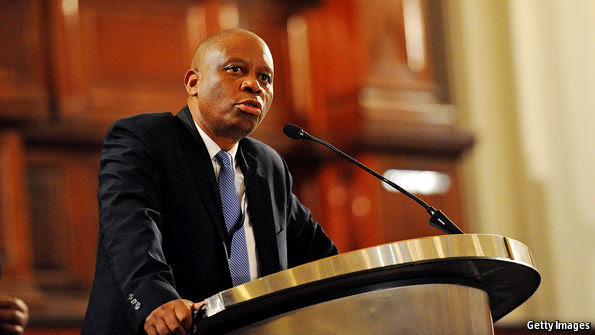
Afro capitalist at the helm

A FEW weeks after Herman Mashaba became mayor of South Africa’s biggest city, tragedy struck. A group of illegal miners known as zama-zamas (“chancers”, for the risks they take) were trapped in an old mineshaft at Langlaagte, the Johannesburg farm where prospectors first discovered gold in 1886. At least three of them died.

To Mr Mashaba, the disaster was a symptom of the breakdown of law and order. It was also a chance to look for capitalist solutions to lingering problems, such as the sky-high unemployment that makes zama-zamas risk their lives. Langlaagte is the “commercial foundation” of Johannesburg, Mr Mashaba declared in his inaugural speech to the city council a few days later. It ought to be a tourist site, and have its “commercial potential” unleashed.

Mr Mashaba, 57, calls himself the “Capitalist Crusader” (the title of a book he published last year). Among South African politicians he is a rare breed: a scrappy self-made millionaire, a libertarian and a capitalist in a country so left-leaning that even the...Continue reading

from Middle East and Africa http://ift.tt/2dmopPl
via https://ifttt.com/ IFTTT

The real game of thrones

IF YOU turned on the news in Saudi Arabia a decade ago, you were likely to see a relatively young, reform-minded prince who was bent on securing the kingdom’s future. Muhammad bin Nayef was out front, dealing with the country’s most pressing challenge, terrorism. He was clever, media-savvy and ambitious. There was little doubt that he wanted to be king.

In April last year, four months after King Salman, his uncle, had ascended to the throne, he duly became crown prince. That was a dramatic break with tradition, because the past six kings of Saudi Arabia have all been sons of the founding monarch and several more are still alive. They were waiting in a brotherly queue. But at last it was decided that the succession would jump a generation. Prince Muhammad bin Nayef, now 57, is officially next up.

That now seems less certain. In the past year King Salman’s own much younger son, also a Muhammad, aged only 31, has burst onto the scene as minister of defence and deputy crown prince, tasked with weaning the kingdom off oil. Overshadowing his older cousin, he has hogged the limelight, promising a string of drastic reforms. King...Continue reading

from Middle East and Africa http://ift.tt/2cUlWt0
via https://ifttt.com/ IFTTT

Gagged in Gaza

LAST month Human Rights Watch (HRW) accused Palestinian authorities of detaining and torturing critical journalists. Two days later the secret police proved the human-rights campaigners right. Plainclothes officers arrested Mohammed Othman, a journalist who has criticised Hamas. He was detained for a day and a half and, he says, beaten, deprived of food and forced into painful positions.

Freedom of speech is enshrined in Palestine’s basic law. However, researchers from HRW found five other journalists and activists who were detained recently in Gaza and the West Bank (which are ruled respectively by the Islamist Hamas and the secular Fatah movements). Most of the detained journalists said they had been tortured. One was threatened by an officer brandishing a gun.

There are few data on such arrests, which both factions deny are politically motivated. Anecdotally, though, many Palestinians say they have increased. Just 20% think they enjoy press freedom, according to a March poll; 66% believe they cannot openly criticise the Palestinian Authority (PA). Even a Facebook post can provoke a visit from the authorities. In May, for example, officers hauled...Continue reading

from Middle East and Africa http://ift.tt/2dmpmY4
via https://ifttt.com/ IFTTT